

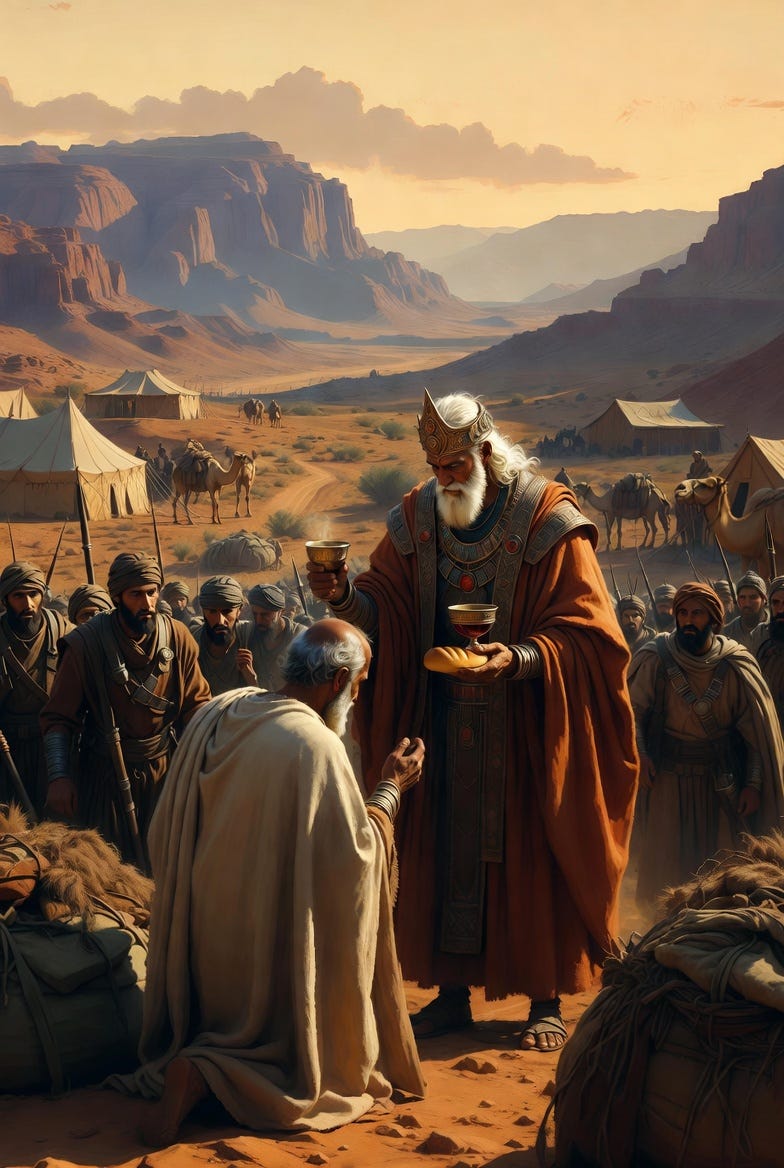
Then Melchizedek, king of Salem, brought out bread and wine, and he was a priest belonging to God Most High. And he blessed him, and he said, “Blessed is Abraham belonging to God most high, Possessor of heavens and earth. And blessed is God most high, Who delivered your enemies into your hands.” And he gave him a tenth from all (Genesis 14:18–20).
In the thirteenth year, the kings of the valley of Sodom who served Chedorlaomer rebelled against him (Genesis 14:4). In the fourteenth year, Chedorlaomer and the kings with him fought against the Rephaim in Ashteroth, Karnaim, Ham, and Shaveh Kiriathaim (Genesis 14:5). These are the giants that roamed the earth before and after the flood who were a perversion of the human nature created by fallen angels propagating with the women of men (Genesis 6:4). Until David’s days, these abominations still roamed the earth.
During Chedorlaomer’s battle with the Rephaim, the king of Sodom and his allies went up against Chedorlaomer and the kings with him. It was four kings against five (Genesis 14:9). The king of Sodom and his allies lost the war and fled. Chedorlaomer then took possession of all the goods of Sodom and Gomorrah, along with the people (Genesis 14:11). Among those taken was Lot, Abram’s nephew (Genesis 14:12).
To rescue Lot, Abram took the trained men of his house and fought against Chedorlaomer, defeating him and the kings with him (Genesis 14:14–15). Abram then brought back all the possessions and people who were taken captive (Genesis 14:16).
Upon Abram’s return, Melchizedek, the King of Salem, who was a priest of God Most High, came out with bread and wine. Melchizedek blessed Abram and God for delivering Chedorlaomer into his hands. Abram gave a tenth of the spoils of war to Melchizedek in response. The tenth Abram gave to Melchizedek had nothing to do with the tithe of the Mosaic Law. Abram gave this willingly, from the spoils of war. By offering Melchizedek a tenth, Abram showed that Melchizedek was greater than himself (Hebrews 7:1–4).