

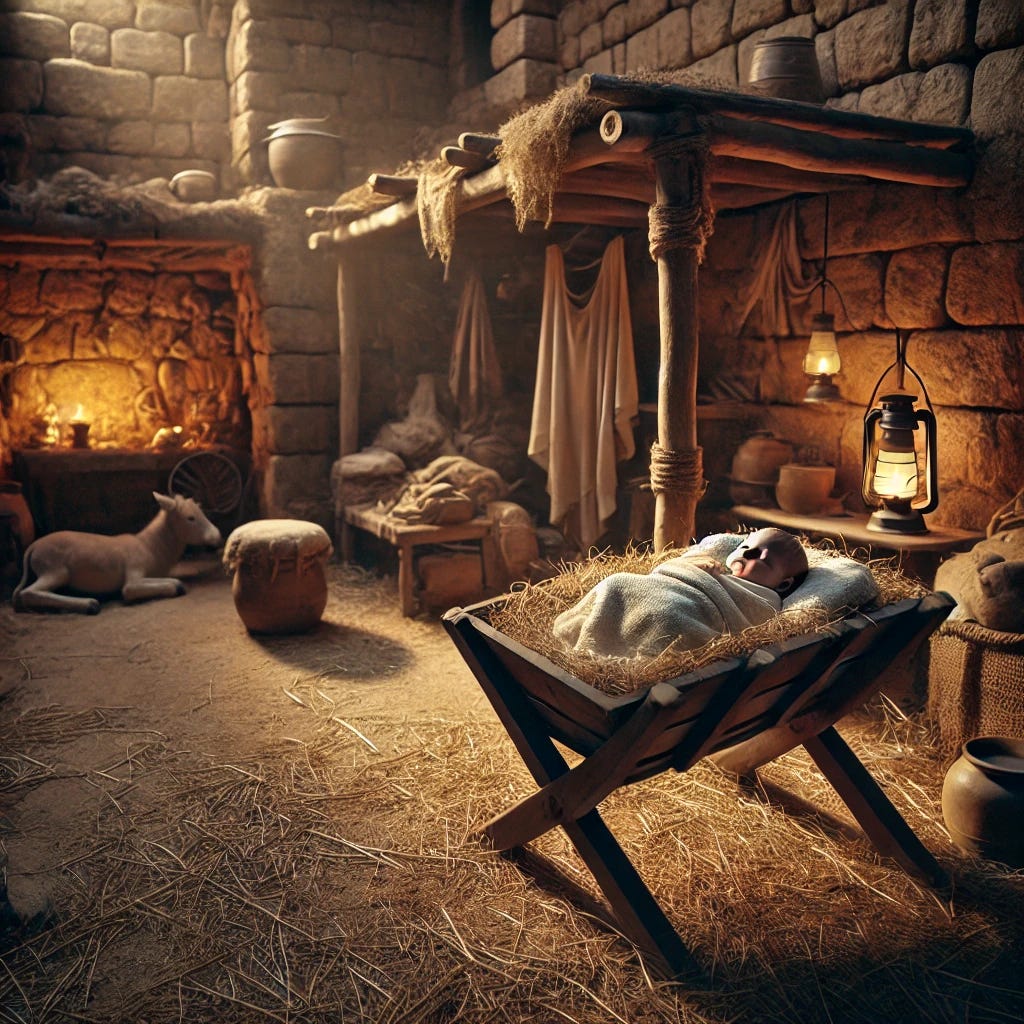
And she brought forth her firstborn, and wrapped him in swaddling cloths, and laid him in a manger because there was no room for them in the inn (Luke 2:7).
Through the prophet Isaiah, God promised to send one who would take away the people’s sins and rule on David’s throne (2 Samuel 7:12–13). Isaiah declared that the Messiah would grow up before the LORD as a tender plant, a root out of dry ground (Isaiah 53:2). Although He is the one who will rule the nations, his coming will be simple. When we see him, he will not have an appearance that is desirable to us – his form and majesty are not what is expected of a king that one would desire to follow, although He is the King of kings and Lord of lords (Isaiah 53:2).
He did not come with pompous decadence, nor to rebuke and judge. He would not break a bruised reed nor quench a smoking flax. He was not there to quarrel with the leaders of Israel, but through His works, he displayed a proper opinion of God the Father and who He was (Matthew 12:19–20). He did not come to judge; His words will judge those who reject Him (John 12:48).
For unto us a child is born, a son is given to us, and the government will be upon His shoulders, and His name will be called wonderful counselor, mighty God, father of an age, Prince of peace (Isaiah 9:6).
In the spring, after the journey from Nazareth to Bethlehem, Mary’s time to deliver her child was at hand. Although perhaps done with good intentions, in the fourth century, when Christianity became a state religion, the proclamation of Christ’s birth was set for December 25th in much of the West, where Eastern assemblies chose January 6th. This decision contrasted with the earlier pagan observances of Saturnalia and Sol Invictus. Christ was proclaimed as the light of the world (John 8:12). Influenced by the prevalence of various pagan religions at the time, certain practices—like lighting candles on a tree and exchanging gifts—became associated with the celebration of Christ’s birth. The original pagan religions have since faded in influence. Today, in many nations, Christmas still remains a time to celebrate the birth of Christ. Although commercialization and secular influences have grown, let us continue to use this time to appreciate God’s love toward man, for He gave us a Savior.